I share real-world lessons from building scalable systems at Jump Trading, Binance, and running mission-critical cloud ops at GovTech and Singapore Air Force. No fluff, just practical takeaways, hard-earned fixes, and deep dives that matter.
A cloud platform that runs full app servers at the edge by deploying containers as Firecracker micro-VMs on bare metal servers across 30+ regions worldwide
You give it a Docker image, it runs it as a micro-VM close to your users. The Fly Proxy handles global load balancing, TLS termination, and auto-start/stop
[[services]]
  auto_stop_machines = "stop"    # Machine will be turned off or suspended when there’s little or no traffic.
  auto_start_machines = true     # Machine will automatically start again when traffic arrives.
There are special settings in the fly.toml file called auto-stop and auto-start (under [[services]] or [http_service]).
auto_stop_machines = "stop" or "suspend" means the machine will be turned off or suspended when there’s little or no traffic.
auto_start_machines = true means the machine will automatically start again when traffic arrives.
min_machines_running sets how many machines stay on even when idle (to avoid cold start delays).
For proper shutdown
If we don’t include auto_stop_machines or auto_start_machines. The system will automatically start machines when needed (on traffic), but it will not automatically stop them when idle.
If the app has a publicly exposed service, any incoming traffic can trigger a machine to start if it was stopped. Make sure you set auto_start_machines = false, so you don’t incur unexpected costs.
Grandfathered Free Tier
Grandfathered = an old pricing rule kept for existing users after a policy change. Newcomers get the new terms, existing users keep the old ones as long as they don’t switch plans
Fly.io retired its public free tier in October 2024. New orgs are Pay As You Go with no free allowance. Orgs that were already on the old Hobby, Launch, or Scale plans keep their allowances: up to 3 shared-cpu-1x@256MB machines, 3 GB persistent volume total, and regional outbound transfer credits
One-way door
The Fly docs warn: “If you change your plan, you won’t be able to return.” Any upgrade or downgrade permanently drops grandfather status. Check the current plan first with fly orgs show <org_slug> or the billing dashboard. Labels Hobby / Launch / Scale = grandfathered, Pay As You Go only = not.
Fly.io Machine Lifecycle
A Fly Machine is a fast-launching container-based micro-VM powered by Firecracker. Each machine goes through lifecycle states: created→started→stopped→destroyed
The Fly Proxy is a reverse proxy that routes incoming traffic to machines, and is responsible for triggering auto_stop and auto_start transitions
Stopped machines persist indefinitely. There is no time-based garbage collection of stopped machines
Rootfs (root filesystem) is the machine’s disk, made up of the container image layers plus any files written at runtime. When a machine is stopped, Fly.io keeps the rootfs assembled on the host for fast restarts, billed at $0.15/GB/month even while stopped. This is separate from volumes (persistent storage via [[mounts]]), which survive machine destruction
Auto-stop and Auto-start Internals
When auto_stop_machines = "stop" is set, the Fly Proxy monitors each machine’s active connections. When a machine is idle (no connections), the proxy cordons the machine (stops routing new traffic to it), then sends a stop signal
auto_start_machines = true works reactively. When the proxy receives a request and all running machines are at capacity or none are running, it starts a stopped machine to handle the traffic
auto_stop only stops machines, it never creates or destroys them
How Machines Can Disappear
Hardware failure on the host. If the host is decommissioned, all machines on it are lost
auto_destroy: true in the machine config (default false). When enabled, a machine destroys itself after it exits
Deployments via fly deploy can replace old machines with new ones (new machine IDs)
Platform incidents can cause machines to temporarily vanish from fly machine list
Preventing Machine Loss
[[services]]
  auto_stop_machines = "stop"
  auto_start_machines = true
  min_machines_running = 1  # Always keep at least 1 machine running
min_machines_running = 1 ensures one machine never gets stopped, so the proxy always has a running machine to route traffic to
Running 2+ machines across regions mitigates hardware failure risk
Lesson from a real incident (2026-03-18)
An Umami analytics instance on Fly.io went completely offline. fly machines list returned “No machines” (destroyed, not just stopped). Root cause analysis:
Hypothesis
Evidence
Verdict
Time-based GC
Not documented, Fly.io bills for stopped machines
Ruled out
auto_destroy
Not in machine config, defaults to false
Ruled out
Deploy replaced machines
No deploy between Jan 7 and Mar 26
Ruled out
Platform API incident
Would be temporary, machines would return
Unlikely
Host hardware failure
Both machines in same region (sin), likely same host. Fly.io decommissions failed hosts and destroys all machines on them
Most likely
Fix: min_machines_running = 1 keeps at least one machine alive. Spreading machines across regions mitigates single-host failure.
Fly.io CLi Cheatsheet
Fly CLi Setup
brew install flyctlfly auth login
App Management
fly apps listfly ssh console -a <APP_NAME>fly image update -a <APP_NAME> # Updates the app's image to the latest available version.fly image update -a umami-self-host --image <IMAGE_ENDPOINT> # Full flexibility in the image we want to usefly config save --app <app-name> # Asks Fly’s control plane for the _current remote configuration_ and writes a `fly.toml` locally.
App Secrets Management
fly secrets list -a <APP_NAME>fly secrets set <KEY>=<Value> -a <APP_NAME>
fly postgres listfly postgres connect -a <APP_NAME>
If you want to view the database using DBeaver on your laptop, you have to first local port forward the db to your localhost port.
App volume
fly volumes create <volume_name> --size <volume_size> --region <region_name> -a <app_name> # create a volume for an appfly volumes list -a <app_name> # inspect all the volume we have
fly.io toml volume attachment
[[mounts]]
  source = <volume_name>
  destination = <container_path_to_attach_the_volume>
  auto_extend_size_threshold = 80      # when usage > 80%, try to grow
  auto_extend_size_increment = "1GB"   # grow by 1 GB each time
  auto_extend_size_limit = "20GB"      # ABSOLUTE cap (must be >= current size)
Fly.io Image Deployment
fly image update -a <app> re-resolves the image tag pinned on each machine and rolls them onto the new digest
Gotcha with mutable tags (:latest, :postgresql-latest): Fly compares the tag string, not the upstream digest. If the tag hasn’t changed, Fly reports “Machines successfully updated” while still running the old digest. Logs reveal the no-op as Container image ...@sha256:<old_digest> already prepared
Verify, don't trust "success"
After every fly image update, check the app version in logs and compare fly image show against the upstream manifest:
fly image update -a <app> --image ghcr.io/<org>/<repo>@sha256:<digest>
Trade-off: once pinned by digest, fly image show reports an empty tag and future fly image update calls without --image become no-ops (no tag to resolve). Either re-pin to the tag afterwards, or always supply a digest going forward
Fly.io Volume Snapshots
Block-level copies of a volume at a point in time, stored on Fly infra. Created without restart or downtime
Crash-consistent, not transaction-consistent. A snapshot of a running Postgres restores like a sudden power-cut, so pair it with a logical pg_dump for anything important
Fly auto-snapshots daily with 5-day retention. Manual snapshots share the same retention unless overridden
Restore creates a new volume from the snapshot, leaving the original untouched. Attach the new volume via fly.toml[[mounts]] or fly machine update --volume
The Unmanaged Fly Postgres image has no official disaster recovery. Before a schema migration or image upgrade, take a Fly snapshot and a logical pg_dump (via local port forward). Snapshots restore the whole disk, pg_dump gives you a portable SQL file that loads into any Postgres version.
Fly.io SSL
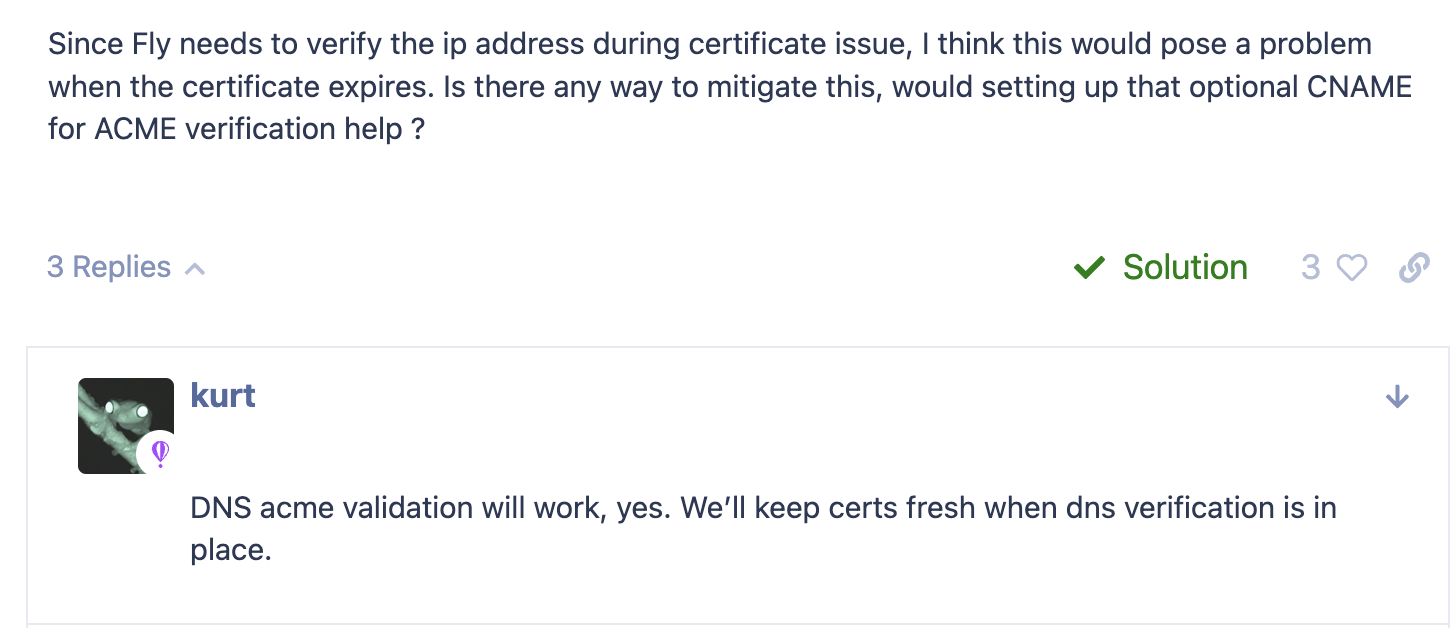
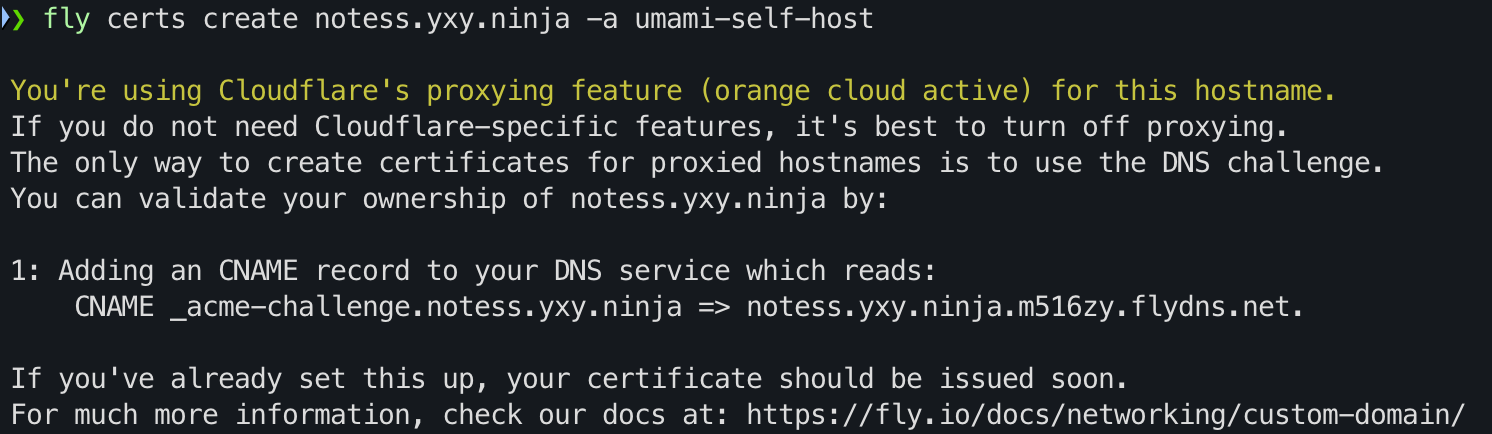
I am using a custom Domain Name with my fly.io app. For some reason, the X.509 Certificate didn’t get auto-renew. This leads to the inaccessibility to the fly.io app. I suspect it is because by the Cloudflare DNS Proxy which causes the custom domain verification to fail. I had to stop the proxy, run fly certs delete <custom_domain_name> and fly certs create <custom_domain_name> to get a valid X.509 certificate again
Yes, I was right!
The only way for domain name verification to work with the Cloudflare DNS proxy on is to add a CNAME record to the domain zone file.